Tuesday, 5 June 2007

SPOTLIGHT ON: HIV/AIDS


May 14th to 20th was Christian Aid week. During that week we saw an interview with one of its ambassadors - R&B star Lemar.

He was talking about this recent trip to Uganda and Ethiopia, the effects on the children of the ongoing civil war in Uganda and the huge problem of HIV and AIDS, including the many children that have lost one or both parents to AIDS.

HIV/AIDS in Africa is a modern day catastrophe - arguably a current holocaust. Over 20 Million African people have already died, 28 million are HIV-positive, over 5000 die everyday. Contrary to popular belief, it is not exclusively an affliction of the poor. It affects artists and aristocrats alike. It particularly flourishes where traditional tribal loyalties have broken down.

Southern Africa is most heavily affected - countries like South Africa, Zambia, Botswana and Zimbabwe - but other African regions don't escape. West Africa - countries like Cameroon, Cote d' Ivoire and Gabon have experienced creeping increases in infection rates. Arcoss Africa, the majority of the people living with HIV/AIDS are between the ages of 15 and 49.

It made us think again about what it is that we need to do to help alleviate the poverty and distress caused by this preventable and treatable disease. In all honesty, the problem is so huge, we have wondered both where to start and what impact we could possibly make. However, one message came through again and again when we looked into things - the situation is tragic but not hopeless.

We can help financially support prevention campaigns and the provision of treatment and care. Ideally financial support should target "grassroots" local organisations. (We thought it best not to recommend ones)

Kafele will be donating money to support "grassroots" individual groups and organisations fighting HIV/AIDS in Africa. In addition, we would like to do more by donating toiletries and medical supplies to an orphanage or hospital/clinic in one or two of the African countries.

We will keep you infomed of our progress with these matters either through the website, blog or our newsletter.

Love Africa, its art and its people.

African-Inspired High-Rise Living

Has anyone heard of The Kalahari, a luxury "green" condo currently under construction on Harlem's 116th street? The exterior of the building is painted with a design from the Ndebele tribe of South Africa whilst inside the apartments boasts recycled bamboo floors and a solor heating system.

I have been following this project and I have got to say that I think it's a positive idea. If the developer's thinking is partly about instilling pride and giving the local community a sense of their heritage, I am all for it. In addition, it is also educating local people about the "green" agenda as this will undoubtly play an important role in the future way we live our lives.

If any developers in the UK are reading this, it wouldn't be a bad idea to develop something like this here in the UK.

To make the building even more authentic, I hope they don't forget to decorate it with African Art!

Monday, 16 April 2007

How can this be?

Kikoi - a brightly coloured cotton fabric from East Africa that is traditionally worn by men and women. Popular in western countries it is commonly used for making bags, hats, throws, curtains and rugs.


I know that I have said, this is a place to relax, feel at peace and explore the mystery and beauty of African art. And it is, but sometimes, something comes along and disturbs that sense of peace and relaxation.

I have recently come across an article that has disturbed my peaceful habitat. Apparently, Kenyan activists are currently fighting to retain the popular kikoi fabric design which is currently at risk of being patented by Kikoy Company UK, a British company. The British company has applied for registration as the sole trademark owner of kikoi.

If permission is granted to Kikoy, it will mean that they will have sole rights over production, marketing, sale and export of Kikoi produced items. It will also mean a loss of income to people in that region.

This is a part of Kenyans traditional culture and heritage, why does anyone think they have the right to steal something that clearly does not belong to them.

Injustice anywhere is a threat to justice everywhere.

-Dr. Martin Luther King Jr.,

Sunday, 1 April 2007

A service of love

Kipoko Mask
Originates from the Kuba people of the Democratic Republic of Congo and symbolises the power of the ancestors.

Many African art pieces are associated with strong moral values which are relevant to our every day lives. Boys and girls during initiation ceremonies are taught the proper ways to relate to each other in relationships and the skills needed to look after and support their families.

African art is charged with a spirituality that is waiting to be unleashed by those that are receptive to its powers. It has the power to convey feelings and messages. Next time you buy a piece of African art, ask yourself why am I drawn to this particular piece? Why does it look the way it does? what would it have been used for? Why was it made? Do I like the way it looks? One of the key things for me is, how does it make me feel? Learning about a particular piece of African art that you are drawn to will give you a deeper understanding of the piece and teaches you the best way of creating balance and harmony in your every-day life.

If you are in a job that you don't like or enjoy, it is like a slow poison being released into your being. You are on the way to a slow but painful death. You need to find that something that fills you with energy, gives you a deep connection and stimulates your being.

I love that I am doing something that I love and that I can offer this back to my customers as a service of love.

Art makes visible the need for change and social transformation. Art is functional, collective, and committed.

- Manthia Diawara

Friday, 23 March 2007

African art is my calling, what is yours?


Lega Statue
These figures are usually owned by high-level members of the Bwami society. Each piece of lega art has a specific meaning and function and is used only by the initiated. These lega statues are referred to as sakimatwematwe (Many-Heads). The story goes that an elephant hunter crosses a river and sees an elephant on the other bank, he goes back to get help from the other hunters but when he returns sees that the elephant has already been killed by the others. In other words, the story shows the importance of being able to see in all directions and to be wise and fair-minded.


Sometimes when we believe so much in what we do, it's hard to find time for our loved ones or for ourselves. We all know how important our families are and also our own health and wellbeing. So, why do we find it so hard to dedicate quality time to our families and ourselves in the same way we do to our jobs and others.

It is such a beautiful and great thing to do, when we dedicate our lives to others and give them our time and energy. We make those others feel loved and cared for. But, how often do we make our loved ones feel just as loved and just as cared for? How often do we take time out to appreciate ourselves?

For the past month, I know that I have seriously concentrated on this piece of machine (my computer). "I have a deadline line to meet, we are re-designing the website and everything has got to be right", I kept telling myself and Jed. I never stopped to ask "at whose expense, have you got to meet those deadlines"? Who will pay the price for me keeping to that deadline? In my case, it was my family and myself. Now that the deadline has passed and I want to spend quality time with my family, I am much too tired to enjoy it. And, I have to wait for Jed to catch up and get off his treadmill!

In Africa the family is very important and we all know the future of our families lies in our children. It therefore, goes without saying that we need to pay special attention in the raising and teachings of our children. If we are to pay the price of feeling tired and worn out then let it be because we have dedicated quality time and energy to our families and loved ones and those others who really need it. Love and appreciate the people in your life while they are around and make sure you don't take them for granted.

Is it a coincidence that since I started writing this article, I have learned that both a customer and a supplier have been unwell? Work-life balance is very difficult for us to achieve. But, if we don't strive to achieve it, we are on our way to a slow death. We can all achieve great things but only when what we do nourishes and feeds our souls. If what we do in our day jobs doesn't live up to that, then find something that you love to create that balance.

I love what I am doing right now in my life. As you know, African art is my passion, it is my calling. Apart from the practicalities of running this business, I really like the opportunity of being able to communicate with people, whether they're customers or not. This is new to me and something that I have learned about myself since doing this business. This aspect, further nurtures my soul. I never knew I had it in me. I am three quarters of the way to surrendering to my calling. How near are you to yours?

In tribal life, one is forced to slow down, to experience the now and commune with the earth and nature. Patience is a must; no one seems to understand the meaning of "hurry up."

- Sobonfu Some

Thursday, 15 March 2007

Life, Death, Life after Death?


This piece of art is produced by the Makonde people of southern Tanzania and is called the "Tree of Life" or Ujamaa. It depicts the members of an extended family both past and present generations, supporting each other, around the family ancestor. Emphasing the importance of both unity and continuity.

Earlier today, a dear friend of mine's father passed away. Today, I feel sad and tearful. Sad for my friend, sad for myself. Tears for my friend and tears for myself. I hope this doesn't sound too selfish but that is honestly how I feel. Hearing about this death brings back all the anxieties and fears that I felt when my mother passed away. It makes me recall the death of other loved ones - my brother, my father-in-law, my friend - and all the other lives that you hear that have been lost.

I don't think that anyone can argue that death is not inevitable. We know that it will definitely happen to all of us one day. The exact time, the exact moment that it will happen, we can never tell. However, is that it? Is there life after death? Who prepares us for death? I used to find death so very frightening but I feel much calmer about it now. Why? I am not sure. Maybe it's about time. They say time is a great healer. Over time I have debated and reasoned with myself and others about the issue, so maybe time and being able to talk about it has helped me to come to terms with death.

My relationship with African art, I believe, has helped me with my view on death. In my deepest darkest moments it has filled me with peace. When I don't want to face the outside world, like today, I find solace and comfort in my arts. In African societies, art has been an important and effective tool in solving problems and overcoming adversity. It encompasses the entire cycle of life from birth, to initiation, through to death and the afterlife. Although removed from their African context and placed in my home, African art has been given a new lease of life. It is no longer an empty shell, it now has soul.

An important function of African art is to honour ancestors or family members that have passed away. In African society, even when a member of the family has died they still play an important role in family life and are recognised through rituals.

I believe the loved ones we have lost watch over us and participate in our everyday lives. We need to ensure in every way we can that they still play an important role in our everyday lives.

Thinking of you.

Wednesday, 7 March 2007

In Celebration of the Women of Africa


The Power comes from women. Even if a man reigns on the throne, one recognizes nevertheless the dignity of the woman as a source of power. It is from her that power emanated.
Banze Mukangala (a luba male office holder)

The 8th March is International Women's Day and although I already know this, I find myself sitting here thinking, a women's life is really tough! We have to be so many things to so many different people and we are expected to balance them perfectly and come out smiling at the other end. Well, I don't know about you but I am exhausted! I have decided that I want to be a man! and have his compartmentalised brain, that can only concentrate on one thing at a time rather than be a woman trying to deal with a multitude of things all at the same time.


When I was growing up, the women that I admired around me, were those that I considered to be very hardworking. They were leaders in their professions. My mother (like most mothers) for instance, was very talented. She was a brilliant chef, a nurse, a cleaner, an accountant, an advisor, a counsellor, a critical friend, a wise woman, and a wife. I admired her dearly and most of all I respected her strength of character.

When I look at the Zulu women of South Africa and the Luba women from the Democratic Republic of Congo, I share the same respect and admiration for them acknowledging the different circumstances, vulnerabilities and the roles they played within their respective societies.

Luba women were important members of their society. In Luba art women were held in high esteem, respected and honoured as spiritual magnates. Female representations were in an array of art forms in a wide variety of poses and contexts. They served as priestesses, political advisers, ambassadors, and also as wives and mothers. In addition to these roles, their bodies served as spirit vessels for deceased males;

Only the body of a woman is strong enough to hold a spirit as powerful as that of a king.


Ngeleka (a Luba male titleholder)

Need I say more?

Zulu women also play an important and crucial role within the nation of the Zulu people. These women are the backbone of the family. They undertake all aspects of domestic life as well as raise the children, look after the elderly and still make money for the family with their skilled artistry. In addition to this they often have to undertake hard manual labour, such as growing crops, looking after livestock and chopping and collecting firewood and water. They do all of this whilst their husbands simply go to work in the cities. Most Zulu women are not allowed to go to work, as it is the belief that a women’s place is in the home. However, this is gradually changing in South Africa and more and more women are going to work in the cities.

Zulu women are renowned nationally and internationally for their weaving of the fabulous beer baskets and bowls. With the help of charitable organisations Zulu women have taken their traditional art and turned it into a means of supplementing their incomes.

There we have it, two examples of the power of women. Did I hear someone say......who needs men?

One is not born beautiful, but rather becomes beautiful over the course of a lifetime.

Luba Proverb

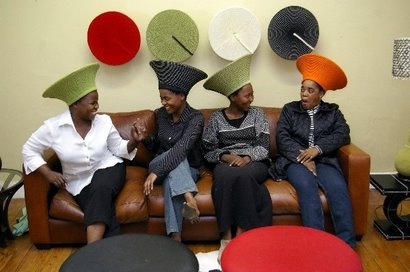
Zulu Hats or Isicholos

Zulu Hats or Isicholos
"It makes me happy" ("Beauty is the promise of happiness") Stendhal - French Author