Saturday, 8 March 2008

To All Women


Today is International Women's Day. This is to all the women that I know and those I have yet to meet.

I was sent this by a wonderful woman that I know, so let me share it with you on this special day. This is an extract from an interview with Maya Angelou on her 70th birthday on the Oprah Winfrey show. She said this:


"I've learned that no matter what happens, or how bad it seems today, life does go on, and it will be better tomorrow." 

"I've learned that you can tell a lot about a person by the way he/she handles these three things: a rainy day, lost luggage, and tangled Christmas tree lights." 


"I've learned that regardless of your relationship with your parents, you'll miss them when they're gone from your life." 


"I've learned that making a "living" is not the same thing as "making a life." 
"I've learned that life sometimes gives you a second chance." 


"I've learned that you shouldn't go through life with a catcher's mitt on both hands; you need to be able to throw some things back." 


"I've learned that whenever I decide something with an open heart, I usually make the right decision." 


"I've learned that even when I have pains, I don't have to be one." 


"I've learned that every day you should reach out and touch someone. People love a warm hug, or just a friendly pat on the back." 


"I've learned that I still have a lot to learn." 
"I've learned that people will forget what you said, people will forget what you did, but people will never forget how you made them feel." 


She is so full of wisdom and so very sincere. 


Saturday, 1 March 2008

I Called Her "Mamma"


Happy Mothers day. This is a day to celebrate the role of women and motherhood.

I lost my mum sometime ago but spiritually we are still connected and I feel she is watching over me every single day.

Do I appreciate her more this day than I do any other day? No I don't but all the hype surrounding Mothers Day has given me the opportunity to remember that I am also a mother as well as remembering my mum (mamma).

I dedicate this piece of art, the Makonde Breast to all Mammas out there. This is another one of my favourite pieces of African art. I love its shape and its meaning.

This special body mask originates from the Makonde people from southern Tanzania and represents a young pregnant woman (amwali ndembo). It is used during the initiation ceremony of adolescent boys and girls and forms part of a costume of a male dancer who wears a matching female mask to protect his identify. Together with a male mask figure, he performs a mesmerizing dance that includes the dramatisation of the burdens of pregnancy and the agonies of childbirth.

This piece is a constant reminder to me, of the miraculous process that goes on inside that 'bump' and the joys of motherhood.

Happy Mammas Day!

Sunday, 13 January 2008

Accra's Art Gallery

I hope it's not too late to wish you all a very happy and prosperous 2008.

There appears to be a number of art galleries opening around the world. Here in our home town we are looking forward to the opening of two new art galleries. And, I have also learnt that Kofi Annan, former UN Secretary General has just opened one in Accra, Ghana.

The gallery is a two million dollar multi-purpose Artists Alliance Gallery (AAG) which will serve as a platform for artists to display their works. He has called on Africans to appreciate their works of art and to recognise its value.

He goes on to say, "Artists tell stories that the journalists, politicians, civil society and opinion leaders would not dare say and this shows the important role arts play in the history of people".

As you already know, African art is our thing, I can feel a trip to Ghana coming on.

"African art feeds the soul and makes our world a better place to live in".

Tuesday, 1 January 2008

Happy Kwanzaa - Imani (Faith)


Today on the seventh and final day of Kwanzaa and the first day of the new year, we celebrate Imaani (Faith). To believe with all our hearts in our people, our parents, our teachers, our leaders and the righteousness and victory of our struggle.


Today as I awake from my bed, I am fighting against all the despair and negativity that I hold in the belief that eventually good will triumph over evil. This really is a time for self-reflection and re-commitment to all that we hold dear and to all that we believe in. Today I look at the work that has been done and the work that still needs to be done and I continue on my journey in the hope that justice will prevail.

My daily reflection on the Nguzo Saba and Kwanzaa in this way, has really helped me to focus, think, reaffirm my self worth and the importance of my family, friends and all around me. I would like to thank Dr Mualana Karenga for his insightfullness, his vision and his creativity. He has provided us with a set of core values that can be celebrated and honoured, not only during the seven days of Kwanzaa but throughout the year and for the rest of our lives.

Heri Za Kwanzaa (Happy Kwanzaa)

Monday, 31 December 2007

Happy Kwanzaa - Kuumba (Creativity)


On this sixth day of Kwanzaa, we celebrate Kuumba(Creativity). To do as much as we can, in whatever way we can, to leave our community more beautiful and beneficial than it was when we inherited it.

I struggle with life's social injustices and sufferings. I often think "what can I do to make things that little bit better." The fact is with a little bit of creativity we can all do our bit to make a difference to someone's life, whether at work or in our personal lives.

Happy Kwanzaa

Sunday, 30 December 2007

Happy Kwanzaa - Nia (Purpose)


On this fifth day of Kwanzaa, we celebrate Nia(Purpose). To make our collective vocation the building and development of our community; to restore our people to their traditional greatness.

I believe we all have a purpose in life. I believe the purpose of Kwanzaa is to make us think, not only about ourselves and our family but also about the community. To think about who we are, where we are and what the future holds. I will never be rich, not in the financial sense of the word but I do feel I am so much richer through my connection with my family, friends and the great many people I have met along the way. I will continue to strive to be the best I can be whilst promoting cultural awareness and practices within the community.

Saturday, 29 December 2007

Happy kwanzaa - Ujamaa (Cooperative Economics)


On this fourth day of Kwanzaa, we celebrate Ujamaa - Cooperative Economics. Let us strengthen our resolve to build and maintain our own shops, stores and other business and to profit from them together.

We believe in the life-affirming necessity of work. But, this should be a place where you can culminate economic practices that demonstrate dignity, respect, fairness, balance, harmony and an opportunity for individuals to grow together.

Thursday, 27 December 2007

Happy Kwanzaa - Ujima (Collective work and responsibility)


On this third day of Kwanzaa we celebrate the principle Ujima (collective work and responsibility). To build and maintain our community together and make our brother's and sister's problems our problems and solve them together.

I can remember when I first came to this country as a little girl, families and friends used to help each other move house, look after each other's children, cook, wash and clean the home if you were ill. Friends and family would rally around and make sure you were looked after. To me this was the spirit of Ujima.

Somehow as a community we have lost this community bond and now we (if you are lucky) make do with a phone call, a text or an e-mail.

Today I will take basic steps to re-connect with family, friends and others so we can start again to build a caring community.

In Celebration of Kwanzaa - Kujichagulia (Self-determination)

On this second day of Kwanzaa, the principle Kujichagulia (Self-determination) is celebrated. This is my favourite principle in the Nguzo Saba. I love the word and it's pronounciation (koo-jee-chah-goo-LEE-ah). You need determination just to pronounce it correctly! Most of all, I love it's meaning as it reflects what I strive to achieve and be.

Kujichagulia to me, means not being afraid to stand for what I believe in. Being true to myself and to others. Define for myself, speak for myself and caring for myself in order to care for others.

Today I will think about what I want from my life, for my family and for the community and strive to make it happen.

Today I will continue to share my culture and spirituality with others through my love of African art.

Happy Kwanzaa

Monday, 24 December 2007

Happy Kwanzaa - Umoja (Unity)


The season of Kwanzaa is here once again. Happy Kwanzaa to all who celebrate it.

Kwanzaa is a African-centred 7-day celebration which was developed by Dr Maulana Karenga in 1966. The aim of Kwanzaa is to reconnect Africans throughout the diaspora to their culture and reinforce the importance of family, community and unity. Kwanzaa is celebrated from 26 December to 1 January and is derived from an East African phrase in Swahili meaning 'the first fruits': matunde y kwanza.

There are seven basic and meaningful principles which are linked to Kwanzaa called the Nguzo Saba - Umoja (Unity), Kujichagulia (Self-determination), Ujima (Collective Work and Responsibility), Ujamaa (Cooperative Economics) Nia (Purpose) Kuumba (Creativity), and Imani (Faith). Each day of Kwanzaa celebrates one of the guiding principles. These seven principles should be practiced throughout the year.

Kwanzaa is celebrated by millions of Africans throughout the African diaspora. However, it is much more popular in America than it is in Europe but it is catching on here.

The traditional way of celebrating Kwanzaa is by decorating a table with the following seven basic symbols - the first one being Mkeka (a mat) which represents African history and the foundation we need to build. The following six symbols are placed on the Mkeka or next to it; Mazao (the crops) which represents African harvest celebrations and plentiful fruits and vegetables; Kinara (a candle holder) which is symbolic of African ancestors; Mishumaa Saba (seven candles) which represents the seven principles which we should strive to live by; Muhindi (ears of corn) symbolises our children; Kikombe cha umoja (the unity cup) symbolic of the principle and practice of unity and Zawadi (gifts) these are normally hand-made.

In addition to the symbols don't forget to include African art in your decoration.

There is currently a debate going on about Kwanzaa and it's meaning and whether we should be celebrating at this time of year or not. Our answer to that is we all have choices, if it is something that you feel you can buy into and celebrate go ahead, if not leave it well alone. Simple.

These principles are ones that can apply to all our everyday lives. Today is the principle Umoja which means to strive for and maintain unity in the family, community, nation and race.

Today I am grateful for the relationships that I have with my family and friends. But, I am also very grateful for the many wonderful people that I have come into contact with over time. Today I am responsible for all those I have met and all those I am still to meet.

Happy Kwanzaa.

Monday, 12 November 2007

Where Africa Comes Alive

Africa is too often ignored, misunderstood and feared but 'The Africa Channel' Where Africa Comes Alive is putting a stop to that. This has got to be our favourite African channel. There is not an awful lot of programmes to choose from, but what is on offer is very professional and entertaining. To us, it's a start and it puts Africa on the global map as being progressive, culturally diverse and exciting.

One of our favourite programmes is "Studio 53" a magazine show depicting the rich and the beautiful. The number '53' represents the 53 countries in the African continent. I also love 'Africa within' although that appears to centre more around South Africa. In both shows we can indulge in our passion and view African art to our hearts' content.

The Africa Channel gives you a perspective on what it's like to be an African. The Africa channel where Africa really does come alive.....we love it!

Saturday, 29 September 2007

Beeping - A new style of African art on the market!

I have just read both an interesting and amusing article on the "African art of beeping". Apparently, when mobile phone users in Africa are low on credit or more likely low on cash, they resort to "beeping" or "flashing" someone and then hanging up before they answer so hopefully the person receiving the call will call them back. The article states that 30 per cent of the calls are just split second flashes. The mobile companies are being swamped by these split second calls and are busting their brain cells trying to figure out how they can make some money out of this.

Oh, I do feel sorry for these companies! Africa has become one of the fastest growing markets for mobile phones and pre-paid accounts dominate the market. Did it not occur to mobile operators when they unleashed those "I can't do without" items on these poor people, that this would be a possibility? In their greed to make money, I think not.

Do you know, just lately I have been getting lots of missed calls on my mobile phone from people I know. I used to think it was the rubbish network that I am on. However, now I know what the real problem is and none of them live in Africa!

Thursday, 30 August 2007

A love affair with the African Textile - Kuba Cloth


I feel excited as we have just taken delivery of a number of kuba cloths made by the Kuba people of the Democratic Republic of Congo (DRC), in Central Africa. Woven by men and embroidered by women these cloths are generally used for ceremonial purposes.

Kuba cloth is woven from raffia palm leaves and were traditionally used for dance skirts by both men and women. The basic kuba weaving unit, an undecorated square of plain cloth, the mbal was also used as a form of currency in the DRC.

I am a great fan of Kuba cloth; in fact I love Kuba cloth. I think it is one of the most beautiful, regal and amazing textiles I have ever come across. I am not the only one that have been captivated by these cloths, renowned artists such as Pablo Picasso, Henri Matisse and Paul Klee were also fascinated by their beauty and reflected the Kuba cloths distinctive geometric and zigzag patterns in their artwork.

Kuba cloth has a wide appeal and is available in many shops throughout the United States and Europe. I have certainly seen it for sale in the form of cushions and re-upholstered furniture in large retail stores, such as House of Fraser and featured in a number of home décor magazines such as Elle Décor and Living Etc. It has also featured in popular TV shows such as My Wife and Kids, All of us, Frasier and Law and Order. I have to say, whenever we go into a high street shop and see genuine Kuba cloth and other African art it makes us feel happy as it brings the beauty of Africa art and design to a wider audience.

Kuba cloth is as beautiful as it is delicate. Although raffia cloth is generally strong, you will need to treat it with care. Think of it as a long lasting relationship that you would like to preserve. Treat it with respect and it will repond well.

If you are looking for fabric to beautify your home or your surroundings then you will find it in the elegant and timeless Kuba cloth.

See Décor tips on www.kafele.co.uk for ideas on using Kuba cloth.

Where has the African sun gone?

I am sorry that I haven't spoken to you for a while. The summer months haven't worked out as well as they should have and instead of feeling perky, I feel a little bit under the weather. We had plans to spend a lot of time outdoors, in our little African art retreat. But as you know, rain and more rain put a stop to that! When we did have a few sunny days, it was such a shock to the system. By the time I recovered, those sunny days had passed me by.

Our daughter is now preparing to return to school and that is a stark reminder that summer is coming to an end and those Autumn months will soon be here.

On a brighter note, we managed to visit an African art exhibition in London. In fact, it was part of a wonderful culturally inspiring week-end we spent with friends. The exhibition itself was pretty small but it was enough to keep us occupied for nearly 3 hours! You see, when we start looking at African art it is serious business and nothing gets past our beady eyes!

Sunday, 1 July 2007

4 things I know about Oprah Winfrey


I am not sure that I have clear or sound views on Opray Winfrey; after all I don't know her. My views can only be based on what the media has said about her and my gut instincts. But, I am clear about 4 things and that is - she has done a lot of good for others, she is very rich, she is an influential woman and she promotes African art.

Opray is now planning to open a new store in Chicago, near to her Harpo Studios, to sell her own merchandise as well as African baskets and art.

I am sure this will be a major tourist attraction but for me it provides another outlet to promote the beauty of African art, give a much needed boost to the African art trade and give recognition and praise to the very talented and skilled artisans who create them.

It also links in with The Oprah Winfrey Leadership Academy for Girls, located in the town of Henley-on-Klip just south of Johannesburg, which has been lavishly decorated with African art. She also plans to open a second African school, this one will cater for both boys and girls, in the eastern province of KwaZulu-Natal. Lets hope the decor includes African art.

Wednesday, 20 June 2007

An African New Year


Tomorrow, June 21st marks this year's summer soltice. It is a celebration of the longest day of the year and the beginning of the summer.

The summer solstice means we are 4 minutes short of 15 hours of daylight. What are you going to do with those extra hours of daylight? Lets hope tommorrow is a lovely sunny day so we can use those extra hours to chill out and relax and be happy.

In Kemet (Ancient Egypt), summer soltice was the most important day of the year. The sun would be at its most powerful and the nile river would begin to rise. The people of Kemet held special ceremonies to honour the Goddesss Aset, who was said to be mourning for her dead husband Asar and that her tears caused the Nile to overflow. An Accurate prediction of the floods was such an important event for the people of Kemet, that the appearance of the star Sirius, which occurs around the time of the summer soltice, was seen as the beginning of the Egyptian New Year.

It is said that the summer soltice is a time to be happy. It is a time to get rid of the things you no longer want or causes chaos in your life. Tomorrow, celebrate being happy.

Tuesday, 19 June 2007

The Day of the African Child


Saturday, 16 June 2007, celebrated the Day of the African Child. Apparently, this day has been celebrated every year since 1991 and I am afraid to say, I have only just found out about it.

The Day of the African Child was first initiated by the organisation of African Unity. The day is in honour of the memory and courage of thousands of Black school children in Soweto, South Africa, in 1976, who took to the streets to protest the inferior quality of their education and to demand their right to be taught in their own language. During those two weeks of protest, over one 100 young boys and girls were killed and more than 1,000 injured.

Can anyone remember that day? I can. It's one of those painful and ugly memories that you bury somewhere deep inside until......

Each year the day is associated with a different message. This year UNICEF is drawing attention to the issue of Child trafficking.

I know this day has passed but it is never too late to learn something new or to get involved.

If we don't stand up for children, then we don't stand for much.

- Marian Wright Edelman

Our best seeds and our dearest fields - those are our children

- Cheikh Hamidou Kane

Thursday, 7 June 2007

An African Oasis


Bring the indoors, outdoors by creating your own tropical oasis in your garden. Use large sculptural African pieces and African-inspired furniture and accessories, such as cushions and textiles to complement tropical plants, flowers and foliage. Here's how:

Flooring - choose your flooring such as decking, gravel, grass or paving, all can look equally good. But, if you are looking to splash out and lay new decking, choose a hardwood like Iroko, which is made in Africa and looks stunning when laid.

Plants - This is the challenging bit, choosing plants and flowers that make you feel you are somewhere tropical. But, there is a lot of help at hand. Visit reputable garden centres and surf the web to get advice about choosing tropical plants for your garden. Remember, not all tropical plants can survive our winter months.
If, you don't already have an established garden, introduce mature plants into the area. Bamboo, grasses (green and black) ferns, yuccas's, cordylines, banana and cactus plants will all help to create a lush oasis and tropical feel.

Planters - place your plants into the many beautiful planters available from garden centres or large retail stores.

Furniture and accessories - create a stylish African-inspired outdoor space with bright wicker tables and stools. Or if you would like a more natural look there are many beautiful hardwood benches and loungers to choose from. Or, even better, use your own authentic pieces of African furniture but don't forget to take them indoors once you have finished with them.

Finally - accessorise with brightly coloured cushions, textiles and parasols. And, don't forget the lighting a perfect finish to your tropical oasis.

Tuesday, 5 June 2007

SPOTLIGHT ON: HIV/AIDS


May 14th to 20th was Christian Aid week. During that week we saw an interview with one of its ambassadors - R&B star Lemar.

He was talking about this recent trip to Uganda and Ethiopia, the effects on the children of the ongoing civil war in Uganda and the huge problem of HIV and AIDS, including the many children that have lost one or both parents to AIDS.

HIV/AIDS in Africa is a modern day catastrophe - arguably a current holocaust. Over 20 Million African people have already died, 28 million are HIV-positive, over 5000 die everyday. Contrary to popular belief, it is not exclusively an affliction of the poor. It affects artists and aristocrats alike. It particularly flourishes where traditional tribal loyalties have broken down.

Southern Africa is most heavily affected - countries like South Africa, Zambia, Botswana and Zimbabwe - but other African regions don't escape. West Africa - countries like Cameroon, Cote d' Ivoire and Gabon have experienced creeping increases in infection rates. Arcoss Africa, the majority of the people living with HIV/AIDS are between the ages of 15 and 49.

It made us think again about what it is that we need to do to help alleviate the poverty and distress caused by this preventable and treatable disease. In all honesty, the problem is so huge, we have wondered both where to start and what impact we could possibly make. However, one message came through again and again when we looked into things - the situation is tragic but not hopeless.

We can help financially support prevention campaigns and the provision of treatment and care. Ideally financial support should target "grassroots" local organisations. (We thought it best not to recommend ones)

Kafele will be donating money to support "grassroots" individual groups and organisations fighting HIV/AIDS in Africa. In addition, we would like to do more by donating toiletries and medical supplies to an orphanage or hospital/clinic in one or two of the African countries.

We will keep you infomed of our progress with these matters either through the website, blog or our newsletter.

Love Africa, its art and its people.

African-Inspired High-Rise Living

Has anyone heard of The Kalahari, a luxury "green" condo currently under construction on Harlem's 116th street? The exterior of the building is painted with a design from the Ndebele tribe of South Africa whilst inside the apartments boasts recycled bamboo floors and a solor heating system.

I have been following this project and I have got to say that I think it's a positive idea. If the developer's thinking is partly about instilling pride and giving the local community a sense of their heritage, I am all for it. In addition, it is also educating local people about the "green" agenda as this will undoubtly play an important role in the future way we live our lives.

If any developers in the UK are reading this, it wouldn't be a bad idea to develop something like this here in the UK.

To make the building even more authentic, I hope they don't forget to decorate it with African Art!

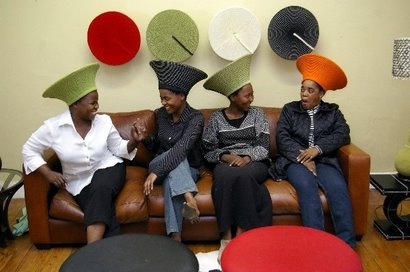
Zulu Hats or Isicholos

Zulu Hats or Isicholos
"It makes me happy" ("Beauty is the promise of happiness") Stendhal - French Author