Saturday, 29 September 2007

Beeping - A new style of African art on the market!

I have just read both an interesting and amusing article on the "African art of beeping". Apparently, when mobile phone users in Africa are low on credit or more likely low on cash, they resort to "beeping" or "flashing" someone and then hanging up before they answer so hopefully the person receiving the call will call them back. The article states that 30 per cent of the calls are just split second flashes. The mobile companies are being swamped by these split second calls and are busting their brain cells trying to figure out how they can make some money out of this.

Oh, I do feel sorry for these companies! Africa has become one of the fastest growing markets for mobile phones and pre-paid accounts dominate the market. Did it not occur to mobile operators when they unleashed those "I can't do without" items on these poor people, that this would be a possibility? In their greed to make money, I think not.

Do you know, just lately I have been getting lots of missed calls on my mobile phone from people I know. I used to think it was the rubbish network that I am on. However, now I know what the real problem is and none of them live in Africa!

Thursday, 30 August 2007

A love affair with the African Textile - Kuba Cloth


I feel excited as we have just taken delivery of a number of kuba cloths made by the Kuba people of the Democratic Republic of Congo (DRC), in Central Africa. Woven by men and embroidered by women these cloths are generally used for ceremonial purposes.

Kuba cloth is woven from raffia palm leaves and were traditionally used for dance skirts by both men and women. The basic kuba weaving unit, an undecorated square of plain cloth, the mbal was also used as a form of currency in the DRC.

I am a great fan of Kuba cloth; in fact I love Kuba cloth. I think it is one of the most beautiful, regal and amazing textiles I have ever come across. I am not the only one that have been captivated by these cloths, renowned artists such as Pablo Picasso, Henri Matisse and Paul Klee were also fascinated by their beauty and reflected the Kuba cloths distinctive geometric and zigzag patterns in their artwork.

Kuba cloth has a wide appeal and is available in many shops throughout the United States and Europe. I have certainly seen it for sale in the form of cushions and re-upholstered furniture in large retail stores, such as House of Fraser and featured in a number of home décor magazines such as Elle Décor and Living Etc. It has also featured in popular TV shows such as My Wife and Kids, All of us, Frasier and Law and Order. I have to say, whenever we go into a high street shop and see genuine Kuba cloth and other African art it makes us feel happy as it brings the beauty of Africa art and design to a wider audience.

Kuba cloth is as beautiful as it is delicate. Although raffia cloth is generally strong, you will need to treat it with care. Think of it as a long lasting relationship that you would like to preserve. Treat it with respect and it will repond well.

If you are looking for fabric to beautify your home or your surroundings then you will find it in the elegant and timeless Kuba cloth.

See Décor tips on www.kafele.co.uk for ideas on using Kuba cloth.

Where has the African sun gone?

I am sorry that I haven't spoken to you for a while. The summer months haven't worked out as well as they should have and instead of feeling perky, I feel a little bit under the weather. We had plans to spend a lot of time outdoors, in our little African art retreat. But as you know, rain and more rain put a stop to that! When we did have a few sunny days, it was such a shock to the system. By the time I recovered, those sunny days had passed me by.

Our daughter is now preparing to return to school and that is a stark reminder that summer is coming to an end and those Autumn months will soon be here.

On a brighter note, we managed to visit an African art exhibition in London. In fact, it was part of a wonderful culturally inspiring week-end we spent with friends. The exhibition itself was pretty small but it was enough to keep us occupied for nearly 3 hours! You see, when we start looking at African art it is serious business and nothing gets past our beady eyes!

Sunday, 1 July 2007

4 things I know about Oprah Winfrey


I am not sure that I have clear or sound views on Opray Winfrey; after all I don't know her. My views can only be based on what the media has said about her and my gut instincts. But, I am clear about 4 things and that is - she has done a lot of good for others, she is very rich, she is an influential woman and she promotes African art.

Opray is now planning to open a new store in Chicago, near to her Harpo Studios, to sell her own merchandise as well as African baskets and art.

I am sure this will be a major tourist attraction but for me it provides another outlet to promote the beauty of African art, give a much needed boost to the African art trade and give recognition and praise to the very talented and skilled artisans who create them.

It also links in with The Oprah Winfrey Leadership Academy for Girls, located in the town of Henley-on-Klip just south of Johannesburg, which has been lavishly decorated with African art. She also plans to open a second African school, this one will cater for both boys and girls, in the eastern province of KwaZulu-Natal. Lets hope the decor includes African art.

Wednesday, 20 June 2007

An African New Year


Tomorrow, June 21st marks this year's summer soltice. It is a celebration of the longest day of the year and the beginning of the summer.

The summer solstice means we are 4 minutes short of 15 hours of daylight. What are you going to do with those extra hours of daylight? Lets hope tommorrow is a lovely sunny day so we can use those extra hours to chill out and relax and be happy.

In Kemet (Ancient Egypt), summer soltice was the most important day of the year. The sun would be at its most powerful and the nile river would begin to rise. The people of Kemet held special ceremonies to honour the Goddesss Aset, who was said to be mourning for her dead husband Asar and that her tears caused the Nile to overflow. An Accurate prediction of the floods was such an important event for the people of Kemet, that the appearance of the star Sirius, which occurs around the time of the summer soltice, was seen as the beginning of the Egyptian New Year.

It is said that the summer soltice is a time to be happy. It is a time to get rid of the things you no longer want or causes chaos in your life. Tomorrow, celebrate being happy.

Tuesday, 19 June 2007

The Day of the African Child


Saturday, 16 June 2007, celebrated the Day of the African Child. Apparently, this day has been celebrated every year since 1991 and I am afraid to say, I have only just found out about it.

The Day of the African Child was first initiated by the organisation of African Unity. The day is in honour of the memory and courage of thousands of Black school children in Soweto, South Africa, in 1976, who took to the streets to protest the inferior quality of their education and to demand their right to be taught in their own language. During those two weeks of protest, over one 100 young boys and girls were killed and more than 1,000 injured.

Can anyone remember that day? I can. It's one of those painful and ugly memories that you bury somewhere deep inside until......

Each year the day is associated with a different message. This year UNICEF is drawing attention to the issue of Child trafficking.

I know this day has passed but it is never too late to learn something new or to get involved.

If we don't stand up for children, then we don't stand for much.

- Marian Wright Edelman

Our best seeds and our dearest fields - those are our children

- Cheikh Hamidou Kane

Thursday, 7 June 2007

An African Oasis


Bring the indoors, outdoors by creating your own tropical oasis in your garden. Use large sculptural African pieces and African-inspired furniture and accessories, such as cushions and textiles to complement tropical plants, flowers and foliage. Here's how:

Flooring - choose your flooring such as decking, gravel, grass or paving, all can look equally good. But, if you are looking to splash out and lay new decking, choose a hardwood like Iroko, which is made in Africa and looks stunning when laid.

Plants - This is the challenging bit, choosing plants and flowers that make you feel you are somewhere tropical. But, there is a lot of help at hand. Visit reputable garden centres and surf the web to get advice about choosing tropical plants for your garden. Remember, not all tropical plants can survive our winter months.
If, you don't already have an established garden, introduce mature plants into the area. Bamboo, grasses (green and black) ferns, yuccas's, cordylines, banana and cactus plants will all help to create a lush oasis and tropical feel.

Planters - place your plants into the many beautiful planters available from garden centres or large retail stores.

Furniture and accessories - create a stylish African-inspired outdoor space with bright wicker tables and stools. Or if you would like a more natural look there are many beautiful hardwood benches and loungers to choose from. Or, even better, use your own authentic pieces of African furniture but don't forget to take them indoors once you have finished with them.

Finally - accessorise with brightly coloured cushions, textiles and parasols. And, don't forget the lighting a perfect finish to your tropical oasis.

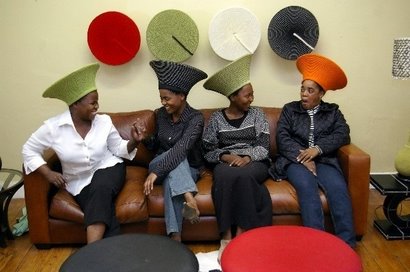
Zulu Hats or Isicholos

Zulu Hats or Isicholos
"It makes me happy" ("Beauty is the promise of happiness") Stendhal - French Author